Japanese Business Culture: Why the Process Matters as Much as the Results.

Have you ever heard of “HORENSO(報連相)“?
In Japanese business, “HORENSO” stands for three essential communication steps:
- HOukoku(報告 – Report)
- RENraku(連絡 – Inform)
- SOudan(相談 – Consult)
While HORENSO is fundamental in Japanese offices, it is often a major “cultural wall” for international professionals.
You might hear Japanese managers asking, “Why don’t my international team members use HORENSO more?”
On the other hand, international employees often wonder, “Why do I need to check in so frequently?”
This gap in expectations can sometimes lead to misunderstandings and negatively impact work. In this article, we will break down the Japanese way of working to help you navigate your career smoothly.
This article is for those who:
- Want to master HORENSO and its cultural nuances
- Need to learn core Japanese etiquette
- Seek to understand the Japanese work style
The True Meaning of HORENSO
Do you truly understand what “Reporting,” “Informing,” and “Consulting” mean in a Japanese context?
Each part of HORENSO focuses on a different timeframe:
- Houkoku (Reporting): Sharing what happened in the PAST.
- Renraku (Informing): Sharing what is happening in the PRESENT.
- Soudan (Consulting): Sharing what will happen in the FUTURE.
As you can see, HORENSO covers the entire timeline of a project.

“Results” vs. “Process”
While achieving results is essential in any business, the Japanese workplace values the “Process” just as much as—if not more than—the final outcome.
Western & European Business Style: Focus on Autonomy
In many Western cultures, there is a strong emphasis on the individual.
Once a manager assigns a task, the most important thing is delivering the result by the deadline.
You are often given the freedom to manage the process yourself, and managers rarely ask for minor updates in between.
Japanese Business Style: Focus on Team Synergy
In contrast, Japanese culture emphasizes teamwork.
Projects are moved forward through the cooperation of multiple members.
To ensure everything goes smoothly, it is necessary for everyone to know exactly who is doing what at any given time.
This is why sharing the “Process” in detail is just as vital as delivering the final “Result.”
The Definition of “Trust”

The concept of “Trust” differs significantly between Western/European and Japanese business cultures.
【Western & European Style: Autonomy & Competence】
In Western business culture, trust is often equated with Competence (the belief in being “Able”).
When a manager trusts a team member, they tend to say, “I’m leaving this to you because you have the skills. Let me know if you need anything.”
Consequently, many professionals feel that they earn trust by completing a task independently without constant supervision.
【Japanese Style: Peace of Mind & Predictability】
In Japanese business culture, trust is equated with Predictability (the belief in being “Understandable”).
Because Japanese companies operate as teams, there is a strong need for the “peace of mind” that comes from everyone sharing the same information.
Therefore, people who provide frequent HORENSO and demonstrate the ability to anticipate future needs are the ones who gain the most trust.
- West / Europe:Win trust by delivering outstanding results.
- Japan:Build trust by providing frequent HORENSO.
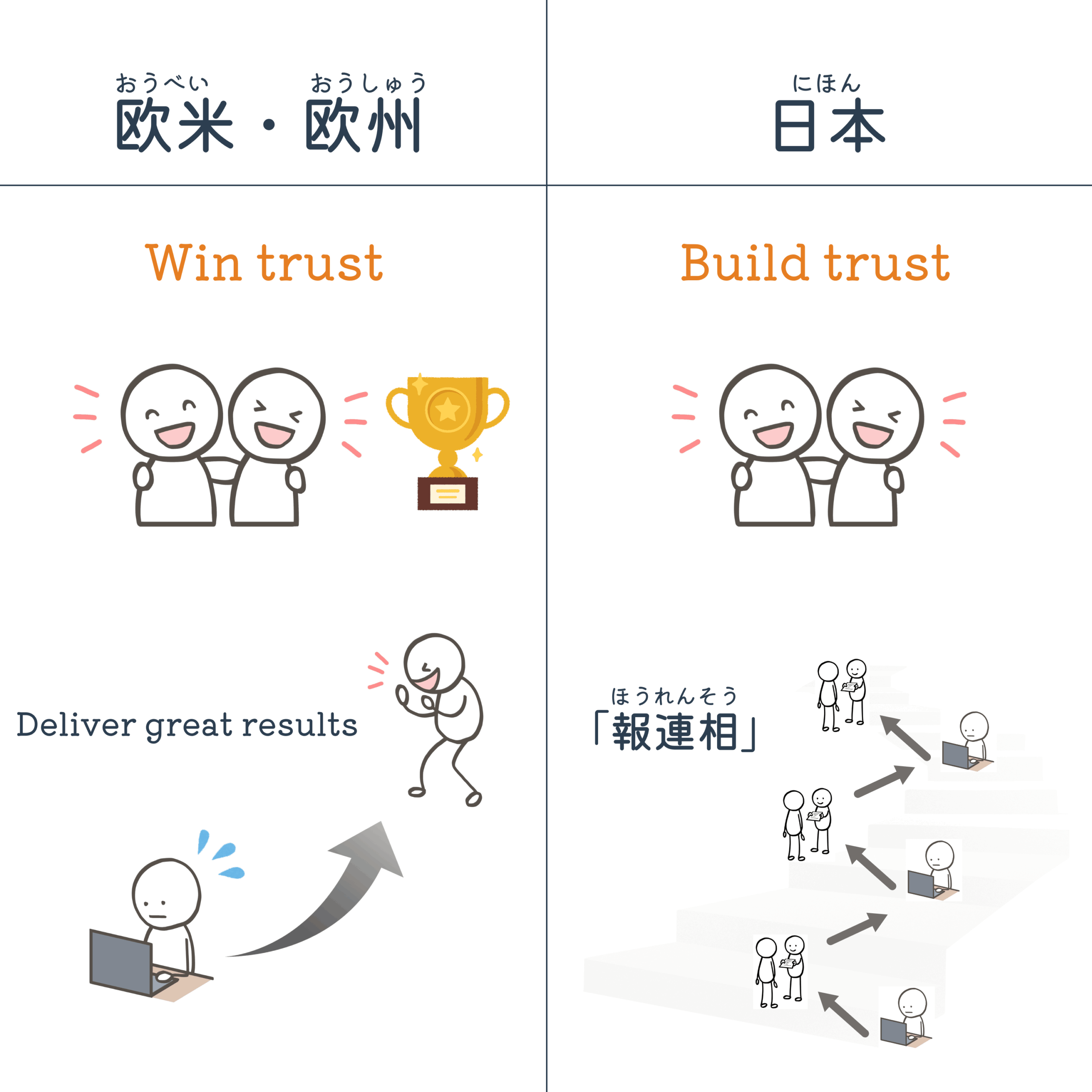
When working for a Japanese company, instead of waiting until the project is finished to report, try to show the “process” through frequent HORENSO. This is the key to building lasting trust.
Why is HORENSO so Important?
Sharing every detail of your progress might make you feel like your competence is being questioned or that you are wasting valuable time.
However, there are three logical reasons why Japanese companies prioritize HORENSO.
1. Risk Management
The one thing Japanese companies fear most is a “major, irreversible mistake.”
Unlike the approach of “solving a problem alone and reporting after it’s fixed,” the Japanese way is to share the problem while it is still small so the entire team can resolve it together.
By practicing HORENSO, your manager can detect risks early and provide timely advice.
In Japan, HORENSO is seen as the ultimate tool to prevent large-scale failures.
2. Teamwork

Japanese companies prioritize the team over the individual.
Rather than one person holding all the information, it is shared among multiple members.
When the entire team is informed, anyone can step in to provide support.
This collective approach is believed to lead to higher overall efficiency.
3. The Manager as the “Ultimate Responsibility Bearer”
In Western and European business, a manager is often seen as a Director—someone who gives instructions and judges the final results.
In Japan, however, a manager is primarily the Responsibility Bearer—the person who takes full responsibility for their team members’ mistakes.
If you make a mistake, it is your manager, not you, who ultimately answers for it.
Because of this, managers feel a strong need to stay updated on every situation so they can “take responsibility” if needed.
Providing frequent HORENSO is, in a sense, a sign of respect, showing your manager: “I appreciate you taking the responsibility for my work, so I am keeping you informed at all times.”
- West / Europe (Top-down): The leader makes quick decisions, and the team follows.
- Japan (Bottom-up): Consensus is built beforehand through HORENSO with all stakeholders (Nemawashi).
While the decision-making process in Japan may take longer, once a direction is set, the speed of execution and the unity of the team are incredibly strong.
3 Benefits of HORENSO
Now that you understand the importance of HORENSO, let’s look at how it directly benefits you.
1. Reduced Pressure from Your Manager
Have you ever been asked by your boss,
“How’s that project coming along?”
“What’s the status of your task right now?”
This isn’t necessarily an attempt to put pressure on you.
Rather, it’s a sign that your manager is anxious and wants to feel “at peace” by understanding the situation.
By providing HORENSO proactively, you eliminate this uncertainty.
As a result, you’ll face less scrutiny from your boss, giving you more freedom and a much more comfortable environment to work in.
2. Boost Your Reputation (Career Growth)

In Japan, being seen as “capable” isn’t just about having high technical skills; it’s about being able to anticipate what’s next and share information proactively.
By providing frequent HORENSO, you don’t just earn the trust of those around you—you actively boost your professional value.
As your reputation grows, you will find more opportunities to be selected for high-profile projects and increase your chances for promotions and career advancement.
Win Allies in the Workplace

If you keep a problem to yourself and only report it when it’s too late, you’ll likely face criticism like, “Why didn’t you say something sooner?”
However, by practicing HORENSO early on, the problem is no longer yours alone—it becomes the “team’s problem.”
When you share information proactively, your colleagues and managers will naturally offer advice and support.
This prevents the burden of responsibility from falling solely on your shoulders, allowing you to navigate challenges with the strength of the entire team behind you.
Conclusion
By now, you should have a clear understanding of why HORENSO is so vital in a Japanese company.
The Japanese business culture is unique and can sometimes feel a bit complex.
However, once you master HORENSO, you will earn the trust of those around you and build a successful career as an indispensable professional in Japan.
Now that you have the knowledge, the next step is practice.
“I want to consult my boss, but I’m not sure how to phrase the email politely.”
“When I translate my business emails from English to Japanese, they sound cold or blunt.”
Does this sound like you?
To help you overcome these challenges, mailun-lab offers specialized learning materials for Japanese business email writing.
[What You’ll Achieve]
- Draft & edit faster
- Communicate with confidence
- Build lasting trust.
\ Join & Get a Free Gift! /
Get your free copy of “Business Japanese Email – Basics” by joining our newsletter!
What’s inside:
*Free Guide (PDF)*
*Discount coupons*
*Pro etiquette tips*