Japanese Business Email Basics: Basic Rules & Greetings , Situational Variations

When you open a business email, the first things you notice are the recipient’s name and the opening greeting.
Getting this right shows that you respect Japanese etiquette and take the time to choose your words thoughtfully.
On the other hand, a mistake here can leave a poor impression, regardless of how good the rest of your message is.
In this guide, we’ll cover the essential opening greetings for any business email.
Let’s master these basics to build trust through your professional writing!
This article is for those who:
- Want to learn Japanese business email openings.
- Are struggling with how to start an email.
\Japanese business etiquette/
「日本で働くためのビジネス基礎講座」
Internal & External: Basic Greetings
First, let’s go over the greetings in the table below.
| あいさつ | ポイント | |
| 同じ会社(社内) | お疲れ様です | 上司・同僚・部下全員OK。 |
| 違う会社(社外) | お世話になっております | どんな相手でも使える。 |
Is “Gokurosama” Rude?

“Gokurosama” is a phrase used by superiors to their subordinates.
In a company setting, it carries a nuance of “I am evaluating/appraising your work,” which can sound condescending.
For example, if you say “Gokurosama-desu” to your boss, they might think, “How rude—they think they are higher-ranking than me!”

The Meaning of “Osewa ni natte orimasu”
People often ask, “Is it strange to use Osewa ni natte orimasu when emailing someone I’ve never worked with or am contacting for the first time?”
Why exactly do we use this phrase even with total strangers?
Future Partnership Sentiment
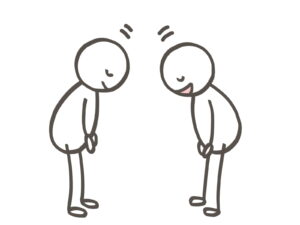
In Japanese, “Osewa ni natte orimasu” is not just about expressing gratitude for the present. It also carries a forward-looking greeting: “I hope to build a good relationship with you from here on.”
Business-to-Business Focus
Even if it is your first time speaking with someone, your company and theirs may already have an existing relationship.
“Osewa ni natte orimasu” is used in a broad sense to say, “As a representative of my company, thank you for your ongoing support.”
Opening Variations
Depending on the context and who you are emailing, you may need to switch up your opening.
Let’s explore some different ways to start your message other than the two most common phrases.
Initial Contact

For first-time emails, it’s polite to include a short phrase before your main greeting. This small touch shows extra consideration for someone you haven’t met yet.
- 「突然のご連絡失礼いたします」
Meaning:Suddenly contacting you, excuse me.
Usage:Used when reaching out to someone you have never met.
- 「初めてご連絡差し上げます」
Meaning:Contacting you for the first time.
Usage:Used before introducing yourself.
Multiple Emails
If you are emailing someone several times a day or sending another message right after your previous one, it is better to use the following phrases instead of (or in addition to) “Osewa ni natte orimasu.”
- 「度々失礼いたします」
Meaning:Sorry for contacting you again and again.
Usage:(1) Used when sending two or three emails in a single day.
- 「重ねて失礼いたします」
Meaning:Once again, pardon me.
Usage:Has the same meaning as “Tabitabi,” but is slightly more polite and formal.
- 「先ほどは失礼いたしました」
Meaning:Pardon me for just a moment ago.
Usage:Used when you need to provide a follow-up or a correction to an email sent anywhere from a few minutes to a few hours ago.
- 「何度も申し訳ございません」
Meaning:I am very sorry for the multiple contacts.
Usage:Used when you know the recipient is busy, or when you feel bad for contacting them multiple times.
After a Long Break
When emailing someone you haven’t been in touch with for a while, it’s polite to include a brief greeting instead of jumping straight into your main point.
- 「ご無沙汰しております」
Meaning:It has been a long time.
Usage:Used for someone you haven’t contacted in quite some time.
- 「大変ご無沙汰しておりますが、いかがお過ごしでしょうか」
Meaning:I haven’t been in touch for a long time, how are you doing?
Usage:It is a more polite expression that shows kindness by showing consideration for the recipient’s recent well-being.
Urgent or Late Night
Using a greeting that fits the situation during late hours or emergencies shows that you are a thoughtful and considerate professional.
- 「夜分遅くに失礼いたします」
Meaning:Sorry for contacting you late at night.
Usage:Used when sending an email late at night.
- 「急ぎ(至急)のご連絡にて失礼いたします」
Meaning:Pardon me for the urgent contact.
Usage:Used when urgent confirmation is required, such as during a crisis or a sudden change in plans.
Avoiding Double Honorifics

When writing business emails, most people naturally want to be as polite as possible to avoid being rude.
However, using too much honorific language in a single phrase can actually result in “Double Honorifics,” which is grammatically incorrect.
What Are “Double Honorifics”?
“Double Honorifics” refers to the mistake of using two honorific forms within a single word or phrase.
In Japanese, stacking too many honorifics can actually make you sound unnatural.
Common Mistakes
① 「おっしゃられる」
- Incorrect Usage:「部長がおっしゃられました。」
- Reason:「おっしゃる(尊敬語)」+「〜れる(尊敬語)」が重なっている。
- Correct Expression:「おっしゃいました」
② 「ご覧になられる」
- Incorrect Usage:「資料をご覧になられましたか?」
- Reason:「ご覧になる(尊敬語)」+「〜れる(尊敬語)」が重なっている。
- Correct Expression:「ご覧になりましたか?」
③ 「伺わせていただきます」
- Incorrect Usage:「明日、10時に伺わせていただきます。」
- Reason: 「伺う(謙譲語)」+「〜させていただく(謙譲語)」が重なっている。
- Correct Expression:「伺います」 または 「お伺いします」
④ 「お受け取りになられる」
- Incorrect Usage:「お荷物はお受け取りになられましたか?」
- Reason:「お〜になる(尊敬語)」+「〜れる(尊敬語)」が重なっている。
- Correct Expression:「お受け取りになりましたか?」
Conclusion
In this article, we’ve explored various “opening greetings” that define your first impression in business emails. Let’s do a quick recap of the key points:
【The Two Basics】 Use “Otsukaresama-desu” for colleagues (internal) and “Osewa ni natte orimasu” for clients (external).
【Avoid “Gokurosama“】Never use this with your boss or people of higher status.
【Tailor to the Situation】Adding a brief remark based on the context will further improve your impression.
【Avoid Double Honorifics】 While the desire to be polite is important, make sure to use honorifics correctly.
It may seem a bit difficult at first, but the most important thing is to show consideration for the recipient.
By mastering the correct greetings, you will build trust and make others feel more comfortable working with you.
To help you overcome these challenges, mailun-lab offers specialized learning materials for Japanese business email writing.
[What You’ll Achieve]
- Draft & edit faster
- Communicate with confidence
- Build lasting trust.
If you found this helpful, feel free to explore our other articles below:

\ Join & Get a Free Gift! /
Get your free copy of “Business Japanese Email – Basics” by joining our newsletter!
What’s inside:
*Free Guide (PDF)*
*Discount coupons*
*Pro etiquette tips*