[Must-Read] Business Japanese Email Tips & Nuances: Are You Using “Sumimasen” Correctly?

Are you truly connecting with the Japanese mindset in your business emails?
You might be aiming for politeness and kindness, but without understanding the cultural nuances, your message may not be resonating as intended.
In Japanese business, writing “correct” Japanese is only the first step—using the right expression for the right situation is what truly builds trust.
In this article, we dive deep into the psychology and subtle nuances behind Japanese business emails to help you navigate these professional waters with confidence.
This article is for those who:
- Want to go beyond “Sumimasen”
- Aim to avoid rudeness and look professional
- Need practical “Cushion Phrases” for tomorrow
Are you using “Sumimasen” correctly?
Do you truly understand the weight and proper usage of the word “Sumimasen”?
Many people use it instinctively without a second thought, but in a professional context, it’s worth taking a moment to re-evaluate.
Let’s take a closer look at whether your usage hits the mark.
1. Why “Sumimasen” is often not enough

Are you relying too much on “Sumimasen”?
While it’s a convenient word, using it in every situation can sometimes make you appear “too casual” or even “lacking a sense of responsibility.”
The word “Sumimasen” carries three distinct meanings: “Excuse me,” “Thank you,” and “I’m sorry.” In a business email, your recipient needs to know exactly what you mean:
- Are you expressing gratitude?
- Are you offering an apology?
- Or are you simply trying to get their attention?
“Sumimasen” can blur these lines. To ensure your message is crystal clear, it’s better to choose specific professional alternatives.
2. The Concept of “Uchi-Soto” (Internal vs. External)
Have you ever heard of the Japanese concept of “Uchi-Soto”?
- “Uchi” (Inside/Internal): Refers to people within your own company (colleagues).
- “Soto” (Outside/External): Refers to people outside your company (clients and partners).
“Sumimasen” is a word reserved for relatively close relationships, making it more suitable for “Uchi” (internal) use.
Using “Sumimasen” with a “Soto” client can sometimes create a negative impression.
In English, it carries a nuance similar to “My bad” or “Sorry about that.”
To maintain a professional tone, “Moushiwake-gozaimasen” is much more appropriate.

“Sumimasen”: Derived from the feeling that “my mind is not at rest” (Subjective). It focuses on your personal feelings.
“Moushiwake-gozaimasen”: Literally means “there is no room for excuses” (Objective). It is a formal recognition of your responsibility for a fact.
In the Japanese business world, expressing objective responsibility is valued more highly than stating personal feelings.
This is why “Moushiwake-gozaimasen” leaves a far more professional impression when you need to apologize.
3. Frequently Used Phrases for Apologizing

Japanese has a variety of ways to apologize.
These four phrases are particularly common—mastering when to use each one will make your communication much smoother.
| 英語のニュアンス | 使用される状況例 | |
| すみません | “Oops, sorry” | 同僚への軽い声かけ |
| 失礼いたしました | “I beg your pardon / I made a mistake” | 誤字脱字、返信の遅れ |
| 申し訳ございません | “I sincerely apologize” | 納期遅延、契約トラブル |
| 深くお詫び申し上げます | “We offer our deepest apologies” | 会社としての重大な過失 |
Spoken vs. Written Japanese

In Japanese, there is a clear distinction between “Spoken Language” (Kogo) and “Written Language” (Bungo).
A business email is considered a formal document that remains as a permanent record.
Many Japanese learners believe that simply using the polite “Desu/Masu” forms is enough to be respectful.
However, in professional emails, it is essential to use specific “written-style phrases.”
For example, compare how you would contact your boss if you were running late for work:
When calling (Spoken): 「電車が遅れており、出勤時間に少し遅れます。すみません。」”Densha ga okurete ori, shukkin jikan ni sukoshi okuremasu. Sumimasen.” (The train is late, so I’ll be a bit late for work. I’m sorry.)
When emailing (Written): 「電車遅延により、出勤時間に少々遅れる見込みです。申し訳ございません。」”Densha chien ni yori, shukkin jikan ni shosho okureru mikomi desu. Moushiwake-gozaimasen.” (Due to a train delay, I expect to be slightly late for work. I offer my sincere apologies.)
Note: While it is perfectly fine to say “Moushiwake-gozaimasen” over the phone, using “Sumimasen” in an email is generally discouraged in favor of the more formal alternative.
As you can see, even when conveying the same message, the choice of vocabulary shifts between speaking and writing.
While “Sumimasen” isn’t strictly “forbidden,” it remains a subjective expression focused on your personal feelings.
In the world of business, your accountability—how you take responsibility for the situation—is more important than your personal feelings.
Relying too heavily on “Sumimasen” can risk making you sound immature or as if you are trying to evade responsibility.
Cushion Phrases
1. What are “Cushion Phrases”?
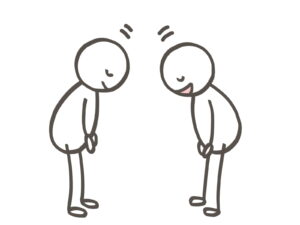
“Cushion phrases” (Kusshon Kotoba) are introductory expressions used when making requests or declining offers.
Like a soft cushion, they wrap your message to ensure it reaches the recipient gently and politely, without causing unnecessary friction.
2. Softening the Impact
Cushion phrases act as a protective layer, showing respect while preventing your message from sounding too aggressive or blunt.
Without them, Japanese people may perceive a message as cold or demanding.
It is especially crucial to use these phrases when sending reminders or turning down a request to show empathy toward the recipient’s feelings.
3. What does “Kyoshuku” (恐縮) really mean?
You will often see the phrase: “Taihen kyoshuku desu ga, go-taio itadakemasu to saiwai desu.”
But what is the actual feeling behind “Kyoshuku”?
It is not a simple “Sorry.” Instead, it is a complex blend of apology for intruding on someone’s time/kindness and deep gratitude for their support.
In Japan, “humility” is a core value.
This does not mean a lack of confidence; rather, it reflects a mindset of: “I am truly sorry for taking up your valuable time. I apologize for intruding into your space.”
Example: Requesting a document review
Imagine you are writing an email to a colleague or client, asking them to review a document.
Western Mindset: “I want your opinion because you are a professional and an expert in this field” (= Respect for the recipient’s ability).
Japanese Mindset: “I feel truly sorry for taking your time—as a busy person with great responsibility—for my own task” (= Respect for the recipient’s status and reflection on one’s own intrusion).
As you can see, many Japanese people place a high priority on being deeply considerate of others.
4. Frequently Used Cushion Phrases
1. O-isogashii tokoro kyoshuku desu ga (お忙しいところ恐縮ですが)
- English Nuance: “I know you are extremely busy, and I feel bad for intruding, but…”
- Tip: Shows that you recognize the recipient’s time is their most valuable resource.
- Nuance: Heavier than a simple “Excuse me.” It conveys: “I understand you are an important, busy person.”
2. O-tesu wo okake shimasu ga (お手数をおかけしますが)
- English Nuance: “I feel sorry for the extra steps/labor this will cause you, but…”
- Tip: Use this when requesting a specific action (reviewing, sending, or fixing something).
- Nuance: In Japanese, “Te” (hand) symbolizes labor. By acknowledging you are using their “hands” (energy), you proactively ease any potential annoyance the recipient might feel.
3. Sashitsuae nakereba (差し支えなければ)
- English Nuance: “If it is not inconvenient for you…” / “If it doesn’t cross any lines…”
- Tip: Use this for questions or slightly personal requests.
- Nuance: It provides the recipient with a polite “exit,” signaling that it is perfectly okay to decline.
4. Makoto ni katte nagara (誠に勝手ながら)
- English Nuance: “Although it is entirely for my own convenience…” / “Selfishly speaking…”
- Tip: Use this when changing plans or pushing your own preferences.
- Nuance: By admitting your request is “selfish” (Katte), you minimize the recipient’s potential discomfort.
5. Osore-irimasu ga (恐れ入りますが)
- English Nuance: “I am filled with awe/trepidation to ask this, but…”
- Tip: Extremely common in professional settings.
- Nuance: It contains a nuance of “Awe” (fear/respect) toward the recipient’s position or status.
Conclusion

In this post, we explored the unique cultural psychology behind the use of “Sumimasen” and “Cushion Phrases” in Japanese business.
In Japanese professional correspondence, the goal is often not to showcase individual confidence, but rather to demonstrate profound respect and humility toward the recipient.
Furthermore, a business email in Japan is more than just a tool for sharing information—it is a vital ritual for building and maintaining long-term trust.
For those who wish to master the art of writing professional emails that truly resonate with the Japanese mindset, we highly recommend the learning materials available at Mailun Lab.
[What you can achieve with Mailun Lab materials]
- Save time: Create professional emails more efficiently.
- Write with confidence: No more second-guessing your wording.
- Earn trust: Build stronger professional relationships through polished communication.
Check out our learning materials here!